The trust layer for agentic AI

Teach AI what your data actually means.

Agents talking to agents is the next phase of AI. It only works if those agents can trust the data beneath them, and today's AI still hallucinates on data it was never taught to understand.

SchemaIQ points AI at your data before production. The AI drafts what every table and field means and scores its own confidence from 0 to 100. Your team corrects what it gets wrong, and only approved, human-checked meaning is served to your agents.

See how it works

We connect a real source, draft definitions, and serve them to an AI in front of you. No slideware.

served to every AI BEFORE CID INT · 48291… ? sqlite customer_id The customer a campaign reached. An identifier, never summed. AI confidence 92 Approved by a data steward
38+connector types
0 to 100self-scored AI confidence
100%human-approved before serving
On-prem or SaaSyour data, your models, your keys
The problem

Your AI is confidently wrong, because nobody taught it your data.

Enterprise columns are cryptic, definitions live in people's heads, and every tool answers with its own version of the truth. Point an agent at that and it does not fail loudly. It answers.

How many customers do we have?
Without SchemaIQ
You have 4,381,920,116 customers.
With SchemaIQ
You have 18,442 customers. (CID is an identifier, never summed.)
A real enterprise team caught the first answer just before it reached a leadership deck. The assistant had summed the customer-ID column.
What was revenue last quarter?
Without SchemaIQ
Three tools, three answers: gross with tax, net of discounts, recognized per GAAP. The agent picks one silently.
With SchemaIQ
One governed answer: recognized net revenue per GAAP, the definition your steward marked as the source of truth.
SchemaIQ reconciles conflicting definitions across sources and tells every AI which one is the truth.
How it works

Four steps from cryptic schemas to AI your team can trust.

STEP 01

Connect everything, harvest what you already have

SchemaIQ reads structure from 38+ source types and harvests the definitions your teams already wrote in dbt, Cognos, Power BI, Tableau, and your catalogs, so you never start from a blank page.

  • Warehouses, databases, BI tools, business apps, documents, any API
  • Existing semantics land automatically as curated source metadata
  • Read-only against your sources. It never changes your data
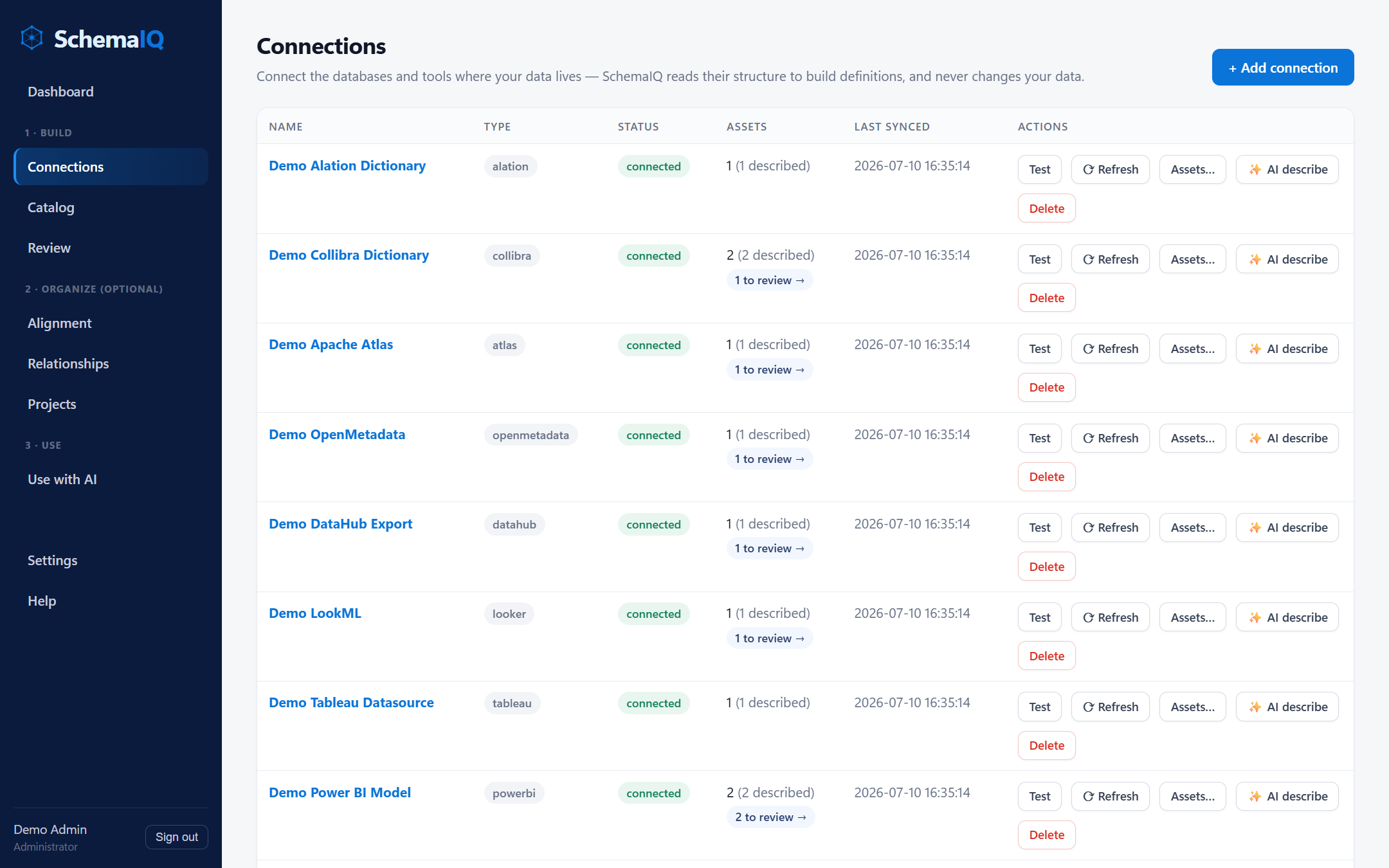
Connections
Connections page with warehouses, BI tools, catalogs, and document sources connected
STEP 02

AI drafts the gaps and grades itself

The AI reads names, types, samples, and harvested context, then writes a plain-English definition for every table and field, scoring its own confidence from 0 to 100.

  • Describe a thousand fields in an afternoon, not a quarter
  • The review inbox surfaces the shakiest drafts first
  • Bring your own AI keys, or run a fully local model
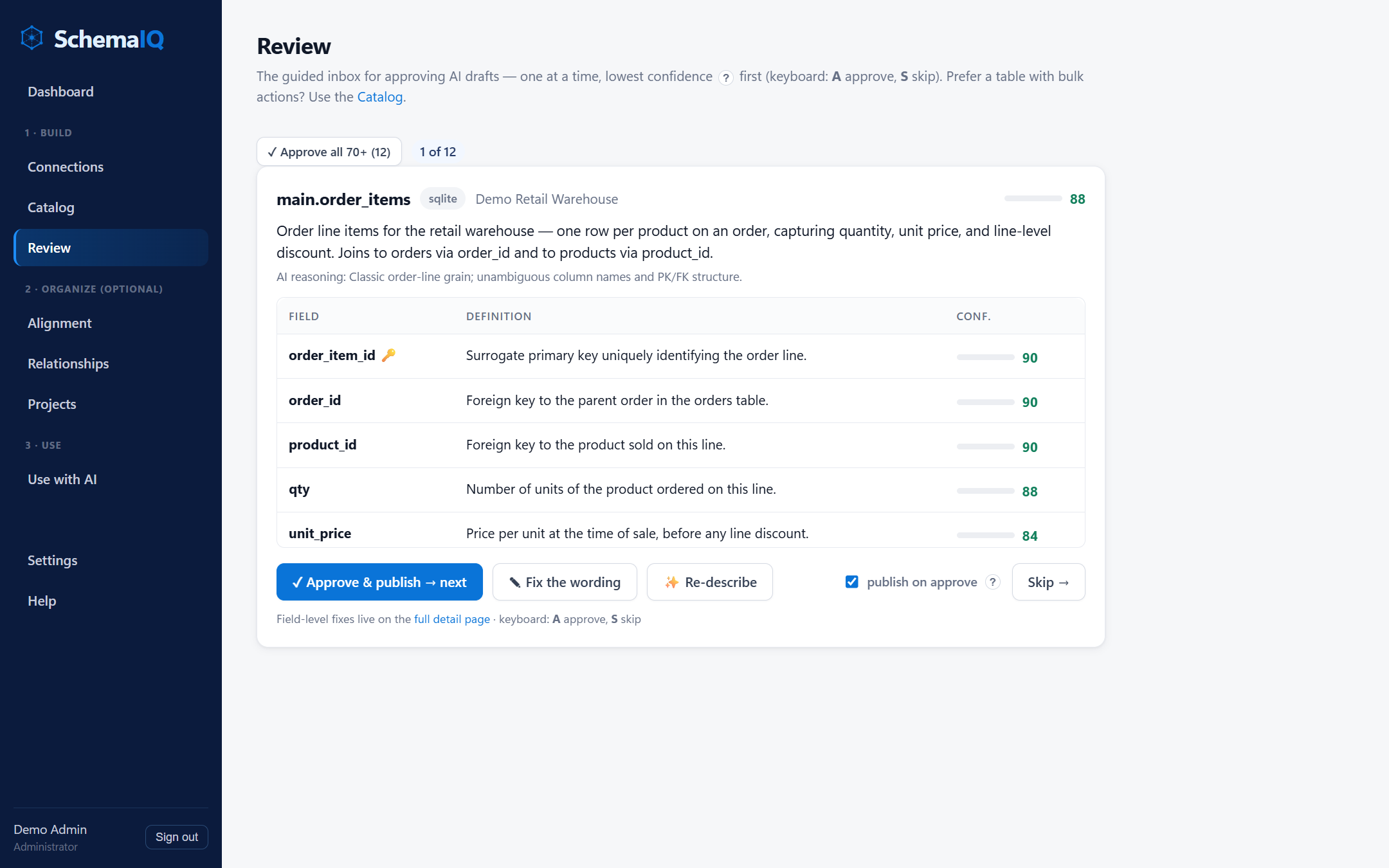
Review inbox
Review inbox: approve AI drafts one at a time, lowest confidence first
STEP 03

Humans stay in control

Your team corrects what the AI gets wrong, and those corrections become the governed definitions. Alignment reconciles the fields that mean the same thing across systems, and a data steward picks the source of truth.

  • Four roles, steward-only approval, server-enforced
  • Every definition records who approved and published it, and when
  • Editing an approved definition sends it back for re-approval
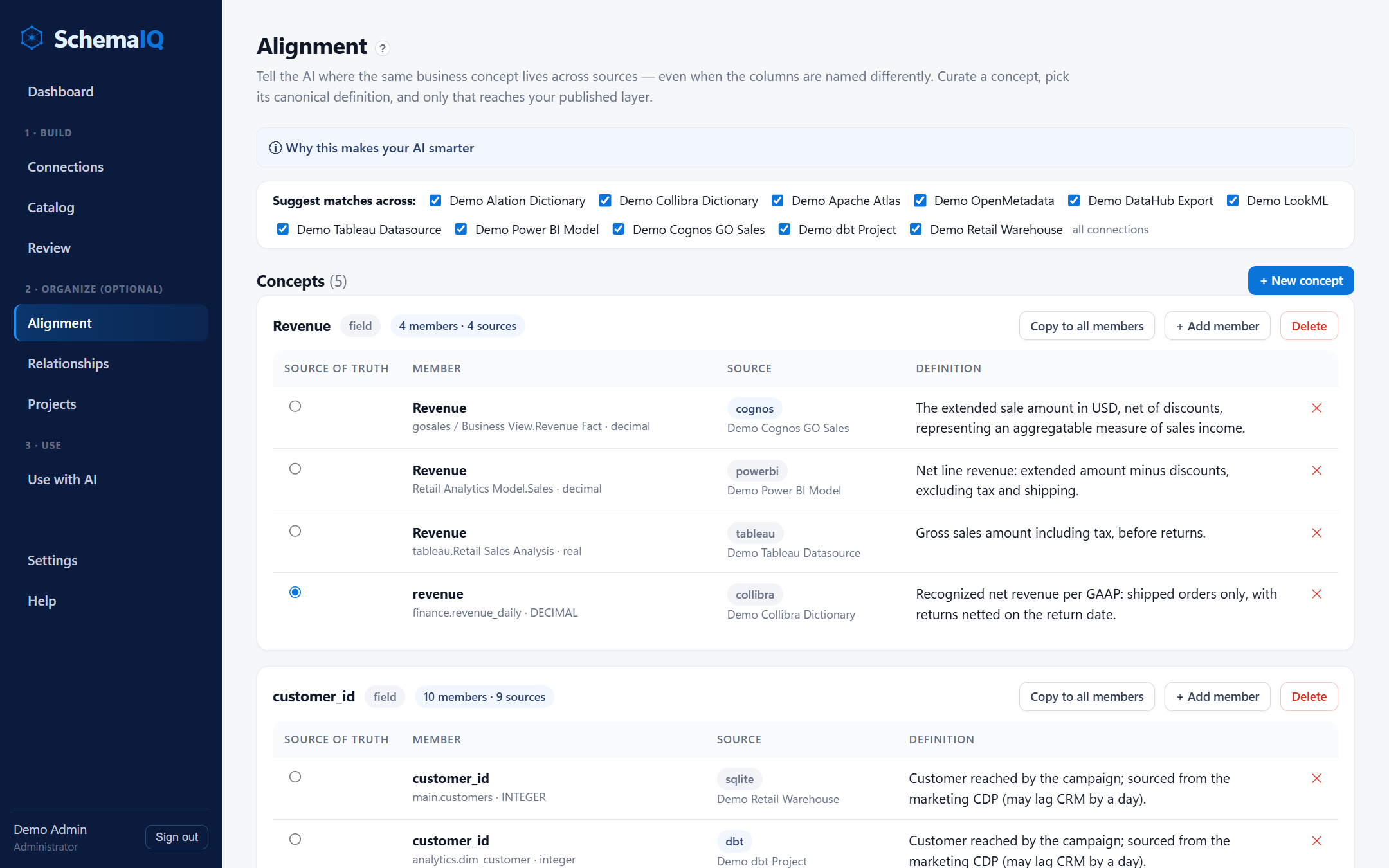
Alignment
Alignment page reconciling Revenue and customer_id definitions across sources
STEP 04

Serve only approved meaning to any AI

Published definitions flow to Claude and any MCP-capable agent, to your applications over a read-only REST API, and to Claude Projects or custom GPTs as clean exports. Drafts are structurally invisible.

  • MCP server, REST API, and Markdown / JSON / YAML exports
  • Nothing reaches an AI until a human publishes it
  • That is what makes agent-to-agent automation safe to turn on
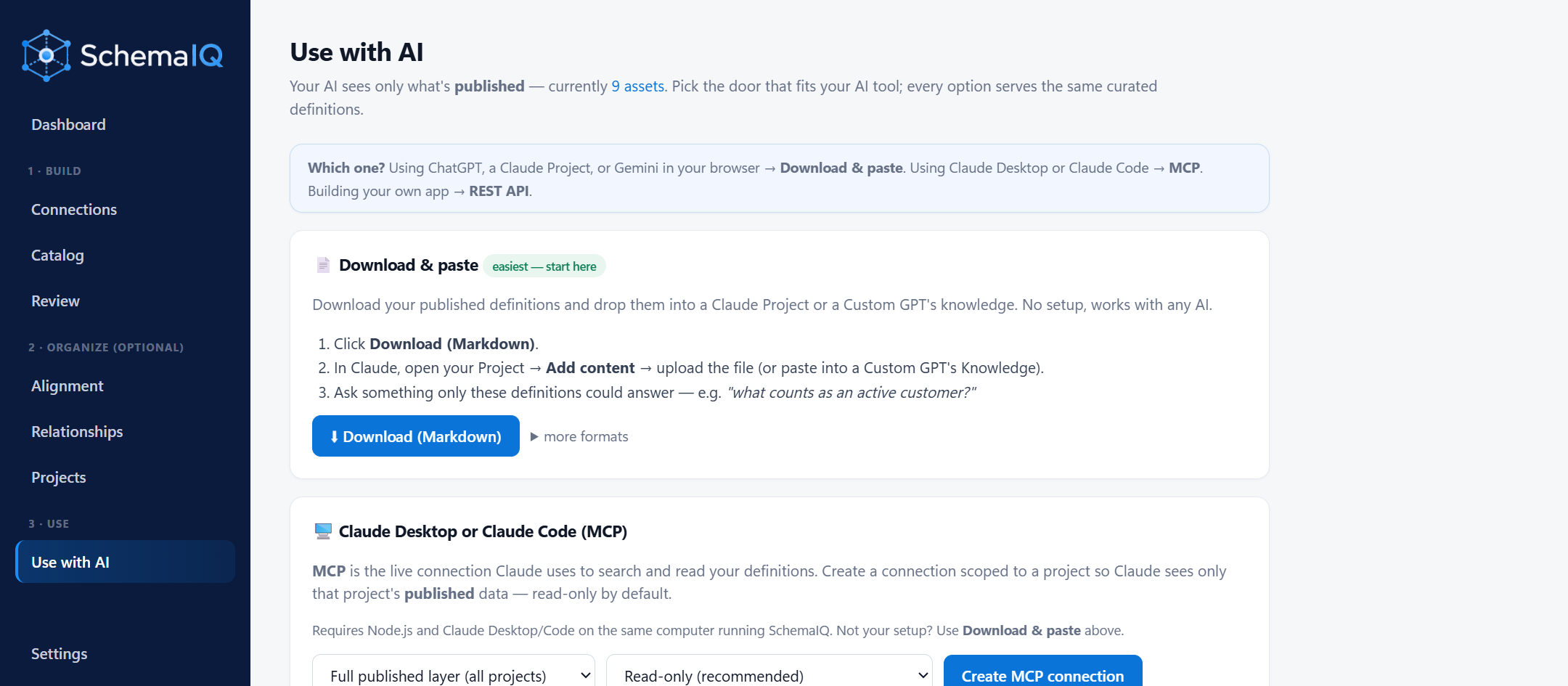
Use with AI
Use with AI: download and paste, MCP connection, and REST API options
Governance

Built for the enterprise reality, not the demo.

One shared, access-controlled catalog per organization. Everyone works from the same definitions, and the system remembers who finalized every one of them.

Governed by design

Four roles with server-side enforcement, steward-only approval, an explicit publish gate, and an append-only audit trail. Editing an approved definition sends it back for re-approval.

One answer across every source

Alignment finds the same business concept across systems, reconciles conflicting definitions, and layers attributes discovered about the same data, so "revenue" means one thing to every AI you run.

Runs where your data lives

Installable on-prem or in your VPC, or hosted multi-tenant SaaS. Bring your own AI keys, or point it at a fully local model. Your data is never used to train anything.

approved_by: Dana R. · Data Steward · 2026-07-17 published_by: Dana R. · 2026-07-17

Accountability is built into the record. Every definition shows who approved it and who exposed it to AI, in the app, over the API, and in the audit log.

Connectors

Meet your data where it already lives.

Databases & warehouses

SnowflakeDatabricksBigQueryRedshiftPostgreSQLSQL ServerOracleIBM DB2MySQLMongoDBClickHouseTrino

BI & metadata

dbtPower BITableauLookerIBM CognosCollibraAlationDataHubOpenMetadataApache Atlas

Business apps

SalesforceHubSpotServiceNowDataverseJiraStripeShopifyAirtableGoogle Sheets

Documents & APIs

SharePointOneDriveDocument foldersREST / OpenAPIODataGraphQL

Metadata tools make it faster, not required. If you already run a catalog, SchemaIQ harvests it. If you run nothing, SchemaIQ is the fastest way to get governed definitions in front of your AI.

Security

Enterprise-grade from the first install.

Credentials encrypted at restAES-256-GCM for every connector secret. API keys are stored only as hashes.
Single sign-onOIDC against Entra ID, Okta, or any compliant provider, with just-in-time provisioning.
Role-based governanceViewer, wrangler, data steward, admin. Enforced on the server for every action.
Document permissions travelSharePoint access lists stay attached to every definition, fail-closed.
Read-only by designSchemaIQ reads structure and samples. It never writes to your sources, and AI consumers get read-only access.
Your models, your keysAnthropic, any OpenAI-compatible endpoint, or a fully local model. No training on your data, ever.
Pricing

Start with one team. Grow to the whole enterprise.

Plans scale by the governance you build: connected sources and governed definitions, not seats. No usage meters, and you bring your own AI keys.

Free
Evaluate on your own data
$0
  • One source, one user
  • AI drafting with confidence scores
  • Sandbox serving
Pro
A builder shipping to production
$600 / month
  • Publish gate, MCP + REST serving
  • Up to 5 sources
  • Email support
Team Most popular
A department's governed catalog
$2,000 / month
  • Full role-based governance + SSO
  • Steward approval & attribution
  • One department's sources
Business
The whole organization, on your infrastructure
Starting at$6,000 / month
  • On-prem / VPC deployment, local LLM option
  • Cross-source reconciliation, org-wide sources
  • Full audit trail and AI project partitions
Enterprise
Unlimited scale, on your terms
Contact sales
  • Unlimited sources, definitions, and projects
  • SLA, priority support, guided onboarding
  • SCIM provisioning and security review

Annual prepay gets two months free. Every plan includes the same core: harvested semantics, AI drafting with 0 to 100 confidence, human approval, and governed serving over MCP and REST.

Who's behind it

Built by the people who live this problem.

SchemaIQ is built by PMsquare, a data, analytics, cloud & AI consultancy founded in 2014, with delivery teams across the US, Canada, South Africa, and Nepal. We built SchemaIQ because we kept watching strong AI projects stall on the same thing: data nobody had ever taught the AI to understand.

It is the product of hundreds of enterprise data engagements, and we run it with our own clients.

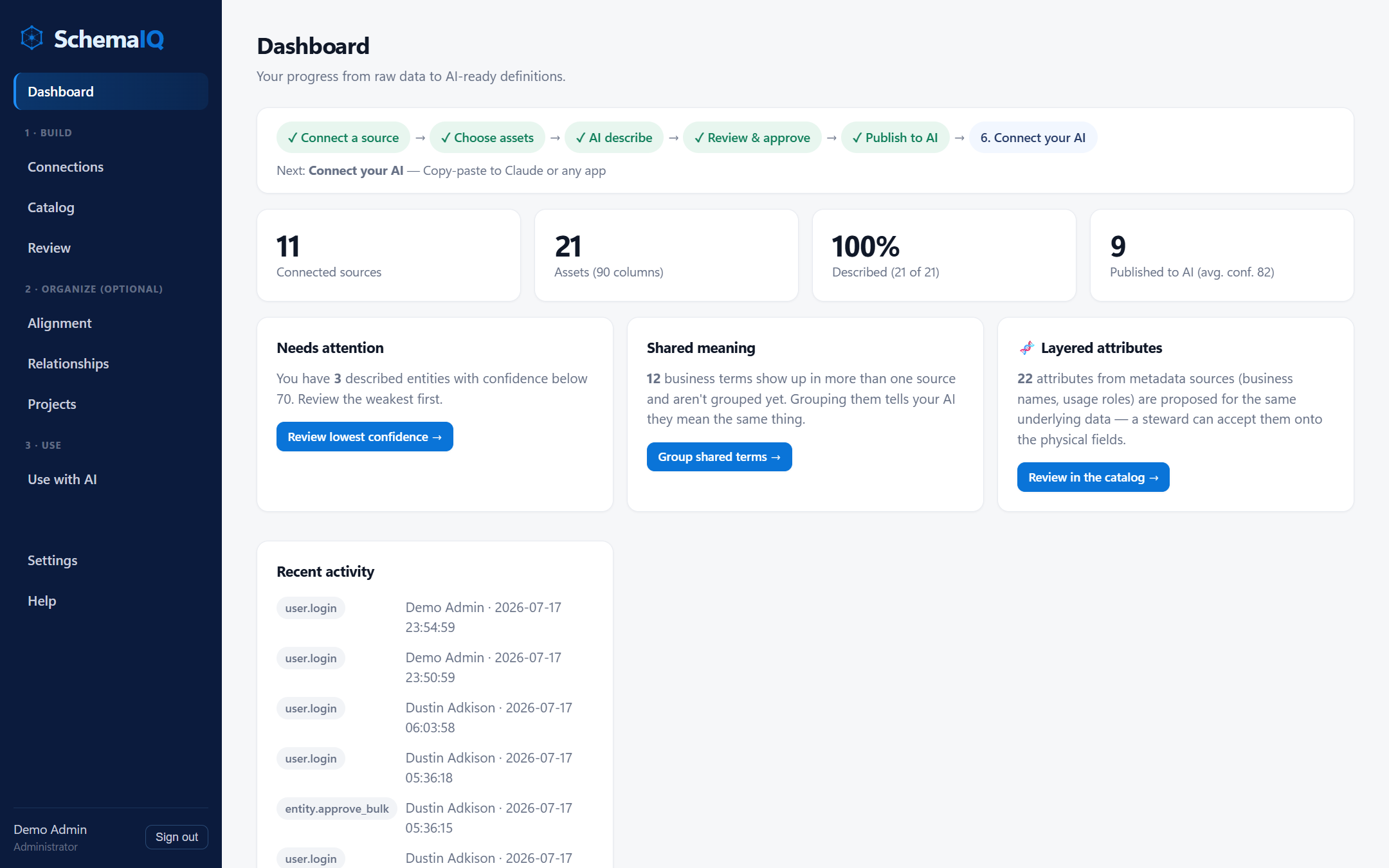
Dashboard
SchemaIQ dashboard with governance progress
FAQ

Questions data leaders ask us.

Does our data leave our network?+

Only if you choose it. SchemaIQ installs on-prem or in your VPC, and the AI endpoint is yours to configure: Anthropic, any OpenAI-compatible endpoint, or a fully local model, in which case nothing leaves your network. Connector credentials are encrypted at rest and your data is never used to train anything.

We already have a data catalog. Why SchemaIQ?+

Keep it. SchemaIQ harvests what your catalog already knows and turns it into something catalogs do not produce: a governed, AI-consumable layer with human sign-off, cross-source reconciliation, and serving over MCP and REST. Catalogs document data for people. SchemaIQ makes it trustworthy for agents.

How is this different from the semantic layer in our BI tool?+

Platform semantic layers are excellent inside one platform. The enterprise problem is that you run many: the same field means different things in dbt, Cognos, and Salesforce. SchemaIQ spans all of them, reconciles the conflicts, and serves one governed answer to any AI, not one vendor's chatbot.

What stops the AI from serving a wrong definition?+

Structure, not hope. Definitions move through an explicit lifecycle: AI drafts score their own confidence from 0 to 100, humans correct and approve, and a steward publishes. Every serving surface filters to published definitions only, so a draft is invisible to your agents. Every approval and publish records who did it and when.

How fast can we see value?+

A small AI team installs and gets value in an afternoon: connect a source, run AI describe, review the drafts, publish, and query it from an AI. That is exactly what we do live in a 30-minute working session on your data.

See SchemaIQ on your data.

A 30-minute working session on your real sources is the fastest way to see it: we connect a source, draft definitions with confidence scores, and serve them to an AI in front of you.

Prefer email? dadkison@pmsquare.com